
On July 16, 2026, an electrical failure at Vantage Data Centers' VA2 campus in Sterling, Virginia, forced the facility onto emergency diesel generation for nearly 24 hours. A nearby resident, Greg Pirio, subsequently told reporters the noise and exhaust were affecting his lungs, forcing him to stay with his daughter in Vienna. The incident became another compelling example of the environmental consequences of data-center development.
But approximately 237 feet from the location of Pirio's reported exposure, Virginia's Department of Environmental Quality had an operating air-quality monitor. Its measurements, combined with two additional monitoring stations and the prevailing meteorology, introduce a materially different perspective on the claim.
The question is not whether the generators operated, or whether the air was polluted. Both are established. The question is whether the generators caused the reported respiratory irritation.
The Advocate and the Narrative
Pirio is not an unfamiliar resident thrust unexpectedly into public attention. By his own account, he is an experienced communications strategist, journalist, and advocate who has spent much of his professional life working on international issues.
His opposition to Vantage substantially predates the July incident. In a June 25, 2026 profile published by the Piedmont Environmental Council, Pirio described organizing Sterling Community Action, engaging officials, coordinating neighbors, and participating in at least 25 media interviews, including outlets such as the BBC and Smithsonian Magazine.
He was already an established public voice criticizing the facility's operations and advocating greater regulatory scrutiny. His professional communications experience and preexisting position provide relevant context for understanding how an individual experience becomes part of a wider environmental narrative.
Neither circumstance makes his observations dishonest, nor does advocacy disqualify someone from experiencing genuine harm. But an experienced advocate's interpretation of an event is no substitute for independently establishing its physical cause.
And in this instance, considerable independent evidence exists.
The Pollution Nobody Needed to Speculate About
On July 17, Virginia experienced what DEQ subsequently described as its smokiest day since air-quality monitoring began in 1999. Canadian wildfire smoke had reached the Mid-Atlantic, producing widespread unhealthy and very unhealthy air quality.
DEQ recorded a 24-hour average PM2.5 concentration of 170.8 µg/m³ in Loudoun County, nearly five times the federal 24-hour standard. Seventeen monitoring stations across Virginia exceeded that standard. NASA subsequently reconstructed the atmospheric transport of Canadian wildfire smoke into the region.
This was not a hypothetical competing pollution source. It was a documented regional atmospheric event of extraordinary magnitude, occurring during precisely the period in which Vantage's generators were operating.
The regional pollution was sufficiently severe that Loudoun County canceled outdoor recreational activities and closed pools on July 17.
Respiratory irritation under those atmospheric conditions was entirely plausible, independent of any incremental diesel emissions.
What the Instruments Actually Measured
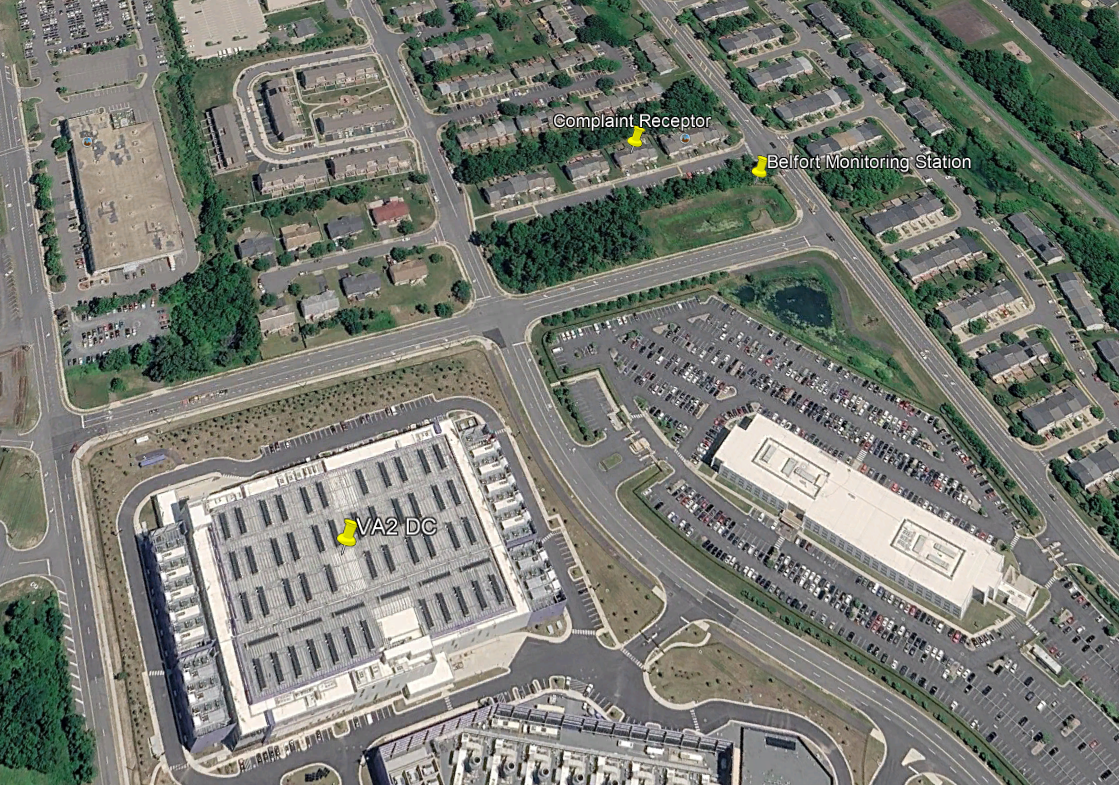
Virginia DEQ had deployed supplemental PM2.5, NO₂, and CO sensors throughout Loudoun County before the incident. One, identified as APEX 14 at Belfort Park Drive, was approximately 237 feet from the location associated with Pirio's complaint.
The nearest diesel emitter was approximately 760 feet from the residential receptor and 810 feet from the DEQ monitor. This provides an unusually close environmental measurement point for evaluating the surrounding atmospheric conditions.
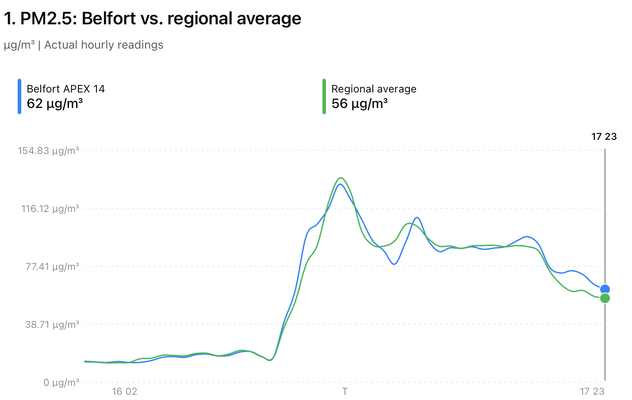
48 hours of historical measurements from Belfort, Broad Run High School, and Sterling Middle School were examined, comparing Belfort against the hourly average of the two more distant stations.
Over that period, Belfort recorded average PM2.5 of 61.91 µg/m³ against a reference average of 60.64. The difference was just 1.27 µg/m³.
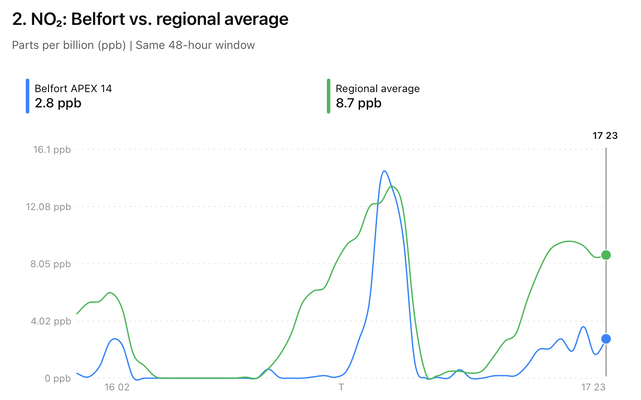
For NO₂, Belfort averaged 1.52 parts per billion against a reference average of 4.39.
The most striking feature was the synchronization of the particulate pollution. All three stations experienced nearly identical timing of the regional surge, with their peaks occurring at the same recorded hour. Sterling Middle School, farther from Vantage, registered the highest peak of the three at 149.53 µg/m³.
The measurements overwhelmingly reflected a common regional pollution episode rather than an unmistakable local source dominating the nearby monitor.
The Wind and the Plume
The generator banks and residential neighborhood also present a testable geometry. The relevant receptors are northeast of the diesel exhaust outlets, making winds originating generally from the southwest favorable for direct horizontal transport.
During the initial regional particulate surge on July 16, winds were predominantly northerly and northwesterly, directing Vantage's exhaust generally away from those receptors.
On July 17, winds became considerably lighter, frequently calm at Dulles, with intermittent southwesterly observations. Those shifts created some opportunities for exhaust transport toward the neighborhood.
But horizontal alignment alone does not establish ground-level exposure. The generators discharge through elevated vertical exhaust systems, where thermal buoyancy and discharge momentum compete with ambient wind and building-wake effects. Under light winds, exhaust may rise above nearby ground-level receptors, although atmospheric stability and building downwash complicate that outcome.
During five observations within the approximate generator operating period when winds fell within the potential transport corridor, Belfort averaged just 1.69 µg/m³ above the two-station PM2.5 reference, while NO₂ averaged 2.93 ppb below it.
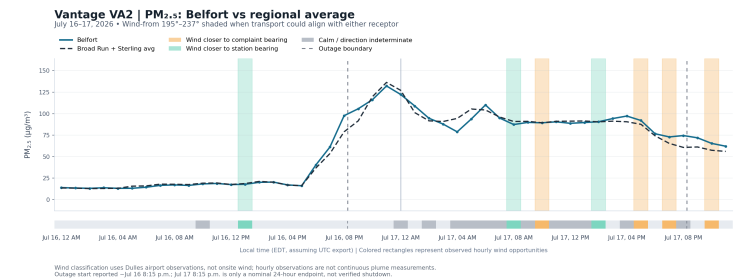
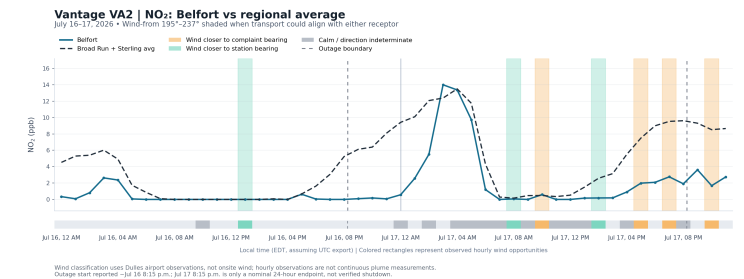
There was no consistent, simultaneous increase in both pollutants at the nearby monitor.
These observations do not establish zero diesel exposure. Sensor calibration, local dispersion, hourly averaging, and the difference between NO₂ and total NOx limit what can be concluded. But neither can the available measurements establish the diesel exposure being asserted.
The Standard Must Be the Same
Datacenters owe the community a rigorous explanation of an electrical failure that require nearly 24 hours of emergency diesel generation. The actual engine count, operating hours, loading, emissions, and applicable permit compliance deserve independent examination.
That obligation does not disappear because the regional air quality was already unhealthy.
Equally, organized opposition and media reporting should not transform an individual's attribution into an established environmental finding without testing it against the available evidence.
A nearby resident may have experienced genuine respiratory irritation, the datacenter unquestionably operated diesel generators. The atmosphere was demonstrably hazardous.
What has not been demonstrated is that the emissions caused the symptoms he attributed to them.
The extraordinary element of this case is that an environmental monitoring instrument was operating within roughly 80 yards of the location in question, yet the available reporting focused predominantly on personal observation rather than the measurements that could challenge or corroborate the asserted cause.
Environmental accountability requires more than believing whichever explanation most comfortably supports an existing position.
The industry must demonstrate the impacts of its operations. Its critics must demonstrate the impacts they attribute to those operations.
The standard cannot change depending on who is making the claim.